
Overview
The MSD Boost Timing Master (BTM) is an electronic device that retards ignition timing under boost to prevent detonation. This guide covers installation on a turbocharged 3S-GTE GT engine, providing crucial engine protection for forced induction setups.
🕒 Time Required: 1-2 hours
💰 Cost: $200-300 (BTM + tach adapter)
🚗 Application: Turbocharged GT engines
Required Parts & Tools
Required Parts
- MSD Boost Timing Master
- MSD Tach Adapter (Part #8910EIS)
- Silicone or rubber vacuum tubing
- Zip ties
Tools Needed
- Wire strippers
- Wire crimps (soldering preferred)
- Electrical tape or heat shrink tubing
- Basic hand tools
⚠️ Important Safety
- Disconnect battery before starting work to prevent ECU damage
- Work on ignition coil wires one at a time to avoid 50,000 volt shock
- Ensure all connections are secure before reconnecting power
- Test system thoroughly before driving
Step 1: Preparation and BTM Placement
Disconnect the battery to avoid any short circuit to the ECU. Locate a suitable mounting area in the engine bay for the BTM. The manual recommends avoiding direct heat exposure. A good location is where the stock air box would be positioned, as nearby venting helps with cooling.
Step 2: Ignition Coil Wire Preparation
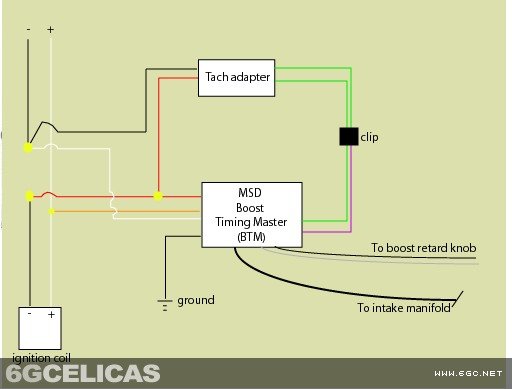
The ignition coil is located on the top of the driver's side firewall. Identify two wires from the coil:
- Positive wire: White
- Negative wire: Black
Safety tip: Cut these wires one at a time to avoid electrical shock. Cut each wire leaving sufficient length on both ends for splicing. Strip both ends of both wires.
Step 3: BTM Coil Connections
Make the following connections between the ignition coil and BTM:
- Black (-) coil wire → Connect to orange BTM wire
- Both white (+) coil wire ends → Connect to red BTM wire
The red BTM wire will need to be spliced to accommodate both white wire connections from the coil.
Step 4: Tach Adapter Integration
Connect the MSD Tach Adapter (Part #8910EIS):
- Red tach adapter wire → Splice with red BTM wire (same connection point as coil)
- Two green wire connector → Connects to BTM's green and purple wire connector (keyed connector - only fits one way)
- Black tach adapter wire → Connect to the other black coil wire end (not the coil-side connection)
- White BTM wire → Connect to same point as the black tach adapter wire
Step 5: Boost Retard Knob Installation
Route the boost retard adjustment knob into the cabin for tuning accessibility while driving. The knob simply plugs into the BTM harness. The gray and black wires can be reversed - polarity doesn't matter for this connection.
Step 6: Ground Connection
Connect the black ground wire from the BTM to a good grounding point in the engine bay. Ensure the ground location is clean and provides solid electrical contact.
Step 7: Boost Pressure Connection
Connect the boost pressure sensing nipple on the BTM to a manifold vacuum source:
- Locate a nipple on the side of the intake manifold (typically has a black cover)
- Remove the cover and connect silicone tubing from BTM to manifold
- Secure connections with zip ties to prevent vacuum leaks
Step 8: Final Testing and Tuning
After completing all connections, reconnect the battery and test the system. Start with conservative settings and tune gradually. The author reports success running 0.75° retard on 93 octane fuel.
🎯 Tuning Recommendations
- Start conservative: Begin with minimal retard settings
- Monitor for knock: Use proper knock detection equipment
- Fuel quality matters: Higher octane allows less aggressive retard
- Professional tuning recommended: BTM is part of a complete engine management strategy
- Proven setting: 0.75° retard works well on 93 octane (author's experience)
💡 Installation Notes
- This installation has been successfully completed on MR2 and GT applications
- Wiring diagram should be referenced during installation for verification
- All connections should be soldered and heat-shrunk for reliability
- Consider this device as engine protection - not a performance enhancement