>
QUOTE(lagos @ May 7, 2007 - 9:07 AM) [snapback]554911[/snapback]
>
a boost leak test will find leaks in the system. from vac lines to IC couplers. any vac/boost leaks on a 3s will play a big role in how the car idles, because youll always be sucking in air that the afm cant account for.
>
QUOTE(x_itchy_b_x @ May 7, 2007 - 9:37 AM) [snapback]554924[/snapback]
>
>
QUOTE(alltracman78 @ May 7, 2007 - 7:39 AM) [snapback]554901[/snapback]
>
A boost leak won't affect idle quality at all.
A vacuum leak will however..
That sounds like an oxymoron.
It's actually not.
A boost leak is when you have positive pressure leaking OUT of the engine system.
A vacuum leak is when you have negative pressure leaking out [air is getting sucked in]
Two totally different things.
A boost leak CANNOT cause idle problems because there is no boost at idle [3SGTE specific here].
A vacuum leak can and will cause problems at idle.
Most of the time if you have one, it will turn into the other once conditions change [from positive to negative pressure].
But it DOESN'T always happen that way. Sometimes an opening will only leak under one or the other.
A BOV/BPV is a perfect example. It's a [controlled] boost leak. As long as it's working right, it won't leak under vacuum [yes I know engine vacuum is used to help open it, but with a weaker spring it wouldn't be needed, and it's on the opposite side of the valve].
With rubber/silicone hoses you can have a cut or opening that will be forced closed by one condition [boost/vac] but forced open by the other.
In addition to this, boost leaks are normally check after the turbo.
Which totally ignores the AFM and hoses between it and the turbo.
And as most of you probably know, with the stock 3SGTE intake hoses there is a very common problem with the hose to the turbo cracking on the bottom.
With a normal boost check this would be ignored.
Which is why I differentiated the two.

A couple of other things, in no particular order.
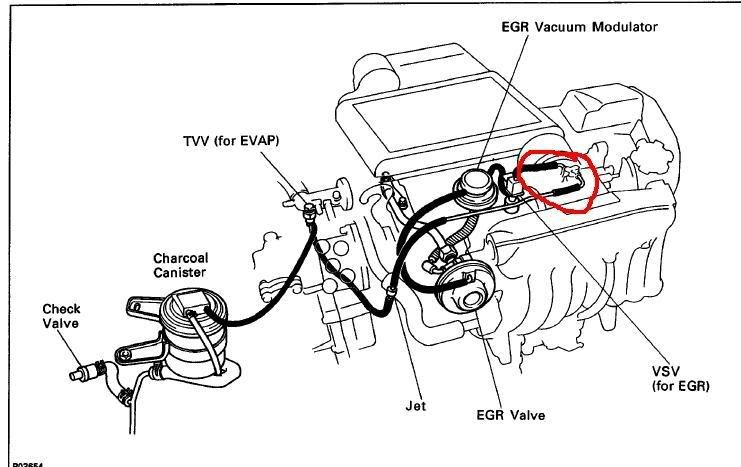
The JDM vacuum routing is actually quite different than USDM.
Differences include
no EGR
different TB hose routing
different ac hose routing
different charcoal canister hose routing
The charcoal canister DOES and IS supposed to vent to atmosphere.....
There are 3 lines.
one from the fuel tank
one to the TVV [USDM] or VSV [JDM]
one to the vent [vents right above the side to side crossmember]
The TVV is a Thermal Vacuum Valve, AKA a BVSV or Bimetal Vacuum Switching Valve. It is a thermally controlled valve. When it gets hot [in this particular case] it opens, allowing the engine to suck fumes from the charcoal canister.
JDM 3SGTEs don't have this. They have a VSV [electronic] on the side of their smaller charcoal canister.
As long as you have 18 - 22 in/hg you are fine.
Book says 15 - 22 in/hg, but IMO anything below 18 is a bit questionable.
Mine raised from 20 in/hg to 22 in/hg just by adding a MSD ignition.
So your first step is to get a GOOD pressure gauge and see where you're at.
If I can remember I'll bring mine from work on the 19th.
I'll show you the vacuum routing then too, I don't have a book diagram, but I have a 100% RC set at work right now.