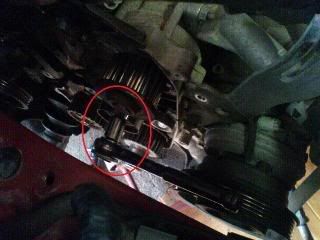
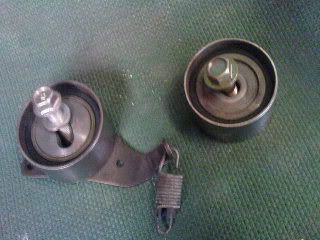
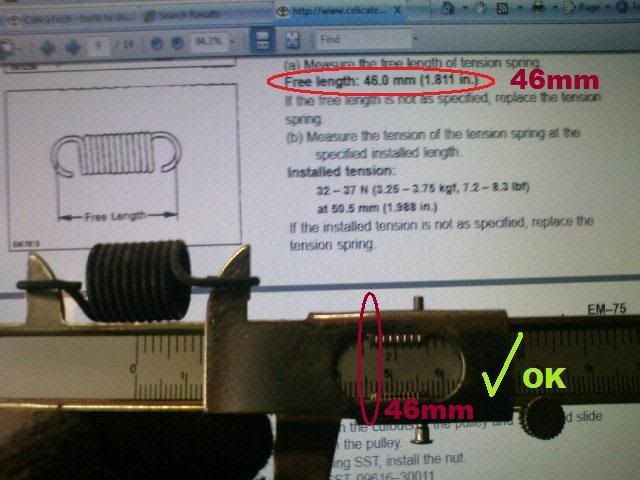
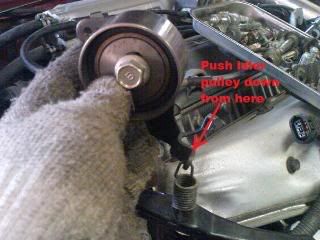
the tensioner pulley should have a spring that sets the tension in the belt.
you might have to check the spring to see if it's in good working condition.
from
How To Replace Your Timing Belt>
QUOTE (azian_advanced @ Apr 16, 2008 - 12:28 PM)

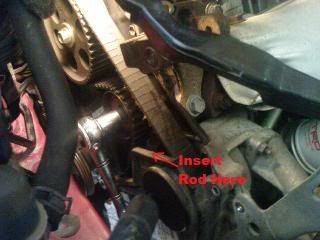
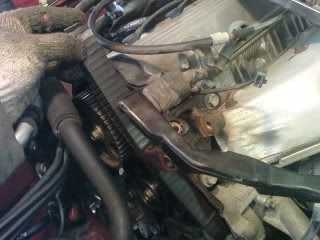
>15. Loosen the tensioner pulley bolt. Use a hard rod (like a socket extension for example) to push down on the part where the spring is hooked on to. Keep it down and retighten the pulley bolt. This loosens the tension in the belt. Remove the belt from the camshaft timing pulley. If you're reusing the timing belt only to replace the oil pump or water pump, then put a mark on the belt and timing pulleys to know where the belt should line up when you put it back on later. Click
here to see an example.
...
21. Now that the belt is off, remove both tensioner and idler pulleys using a 14mm socket. Once off, inspect both pulleys to ensure they can freely rotate and don't wobble or have any cracks or anything. Also inspect the spring ensuring it meets factory specifications. I was only able to inspect the dimensions of the spring but not the tension force of the spring. I guess I can use Hooke's Law (F=kx) if only 'k' was given! LOL

>
>Nerds only: oh wait a sec, actually you can! if the range is 32 to 37 [N] while at 50.5 [mm] or 0.0505 [m] and since F=kx, then k=F/x.
therefore, k(min) = 32 [N] /0.0505 [m] = 633.66 [N/m] and k(max) = 37 [N] / 0.0505 [m] = 732.67 [N/m]. (this is the theoretical ideal range for k).
but you'll also need a known mass hanging on the spring and a ruler to measure its elongation (x) due to gravity.
also calculate the force (F) by multiplying its mass by the gravitational acceleration.
then solve for the actual value for k using k=F/x and compare if it falls in the theoretical ideal range for k.
but i'm too lazy to actually do it, plus i'm on my summer break. no engineering til september!
i'm gonna take my chances and skip the spring force test. meh, if the spring fails on me, then so be it.
>>